
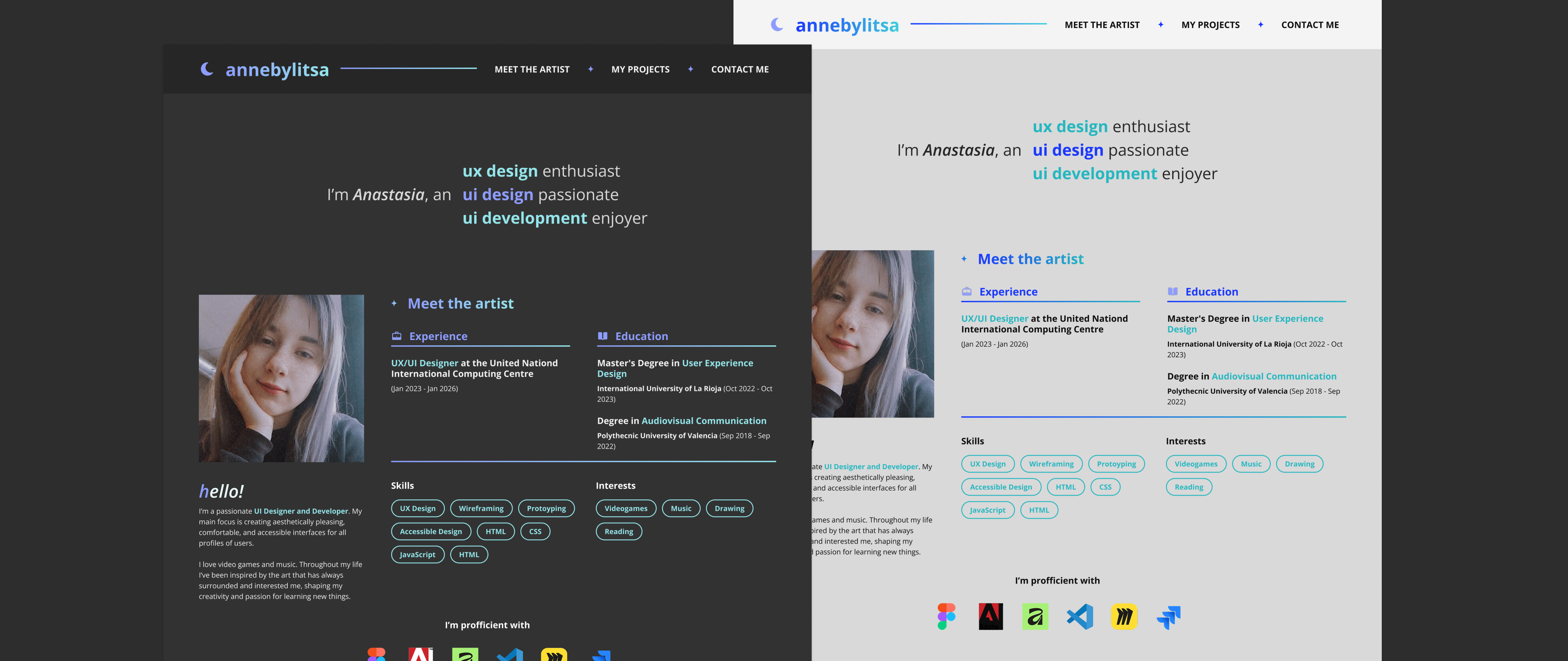

As a UX/UI designer who comfortably worked within an organization during my early career years, I left my first portfolio (a PDF of my university projects) completely forgotten. Digging it up isn’t impossible, but considering how much I’ve grown, I see little value in showcasing my earliest steps in this field. Those projects reflect who I was as a beginner, not who I am today.
This portfolio project should highlight the experience I’ve gained over the years, demonstrate how I work today, and reflect my commitment to continuous growth and learning. While my background is primarily in UX/UI design, I also aim to present myself as an emerging front-end developer, broadening my professional horizons and expanding my skill set.
The main audience I aim to reach with this project is potential employers, headhunters, and HR professionals who are interested in reviewing my work and assessing whether my style and approach align with their expectations and needs.
And perhaps other UX/UI designers or developers looking for inspiration or wanting to share some advice! :)
This is a solo project, so I’ve taken on every role that was necessary to fulfill.
I’m responsible for gathering all the necessary information, researching various portfolios and taking notes, handling the design (creating the design system, wireframes, mockups, etc.), and carrying out the development.
While I have extensive experience working with multidisciplinary teams, tackling this project on my own is a breath of fresh air, especially since there’s no strict deadline.
The main challenge of this project is the lack of other projects I can publicly showcase online. Over the past few years, I’ve had the opportunity to work on various projects with different teams and tasks. However, since I was working for an organization, I don’t have explicit permission from clients to freely display my contributions.
For this reason, I intend to use the creation of the portfolio itself as a project to exhibit. The process I’m following is strictly professional and adheres to the best practices I’ve learned from project to project.
 Discover
I browsed, researched, and explored all kinds of designers’ portfolios. I reached out to them for advice and took detailed notes over it's course.
Throughout the process, I kept my personal situation in mind (lack of projects), so at this stage I was already planning how to adapt everything to reflect what I truly wanted to showcase in my portfolio.
 Define
The insights I gathered helped me structure the project, tailoring it to the specific needs of a portfolio for someone with my experience.
I also started sketching in my notebook how I wanted the landing page to look like, how study case page would look and some other ideas.
DevelopWith the theoretical groundwork covered, I moved on to the technical side. I started working on both low-fidelity and high-fidelity wireframes to visualize the structure I wanted for the website. I developed a small design system, which I used to build the final prototype. With everything ready, transitioning to the development phase was straightforward.
DeliverOnce the project was finished, the need for improvements became clear. One key lesson I learned throughout the process is that something that looks good in Figma doesn’t always translate perfectly to the web. I added new sections, removed others, and adapted the website to achieve a result I was happy with.
After that, I went through the site on different devices and shared it with trusted contacts to gather feedback and address any issues they found.
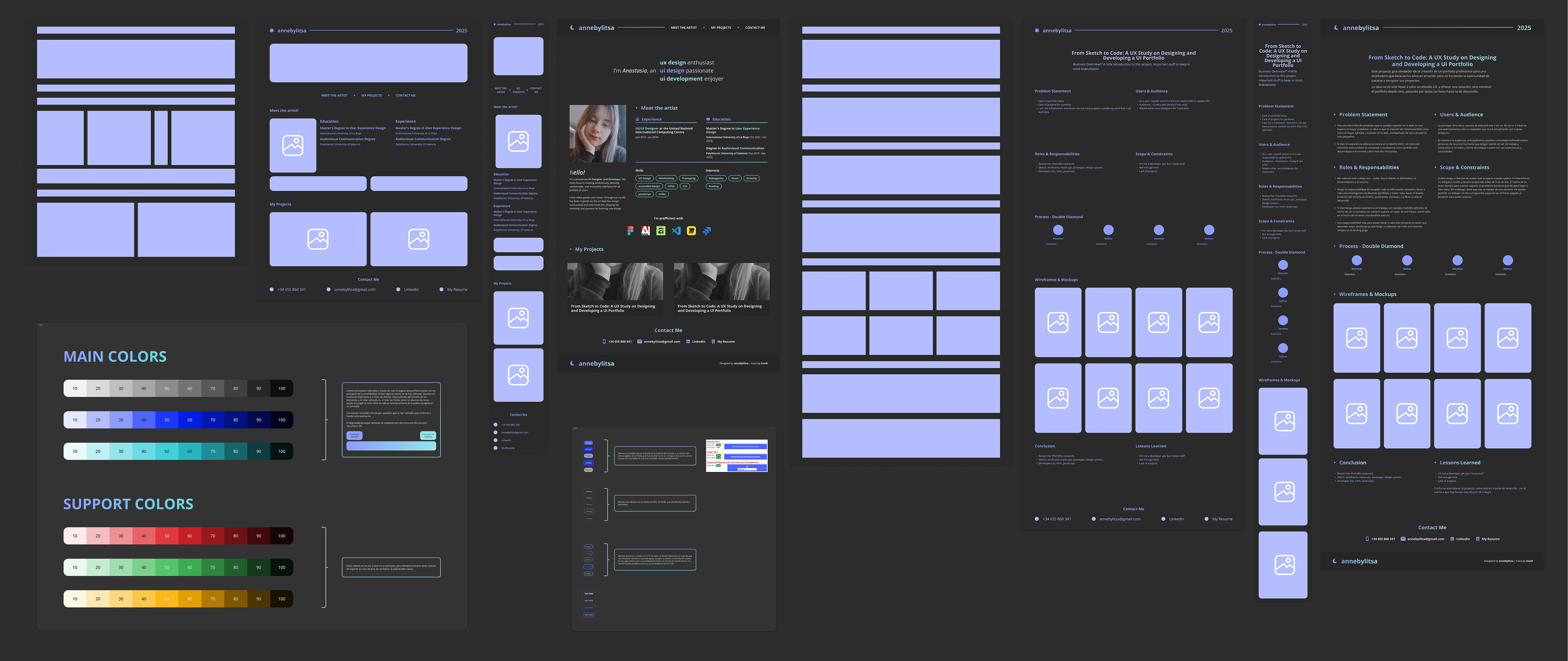
The creative process has undoubtedly been my favorite part of this entire project. It had been a long time since I had the chance to let my creativity and passion for interface design flow so freely.
This isn’t a standard or minimalist portfolio. I have nothing against minimalism, and I myself appreciate its satisfying organization and style — but I wanted to do something different that also reflects my personality. I don’t rule out the possibility of completely changing the structure to something more professional and elegant in the future, but for now, I can confidently say I’m more than satisfied with the result.
As I progressed with the development, I learned more effective ways to organize my code. Moving from the Figma prototype to the actual web was straightforward at first, but I had to step out of my comfort zone to achieve a more satisfying result.
This project has served as a first step, but I feel I could do better, especially when it comes to the internal organization of the code.
However, it has helped me identify where I stumble as a developer, so I can take note and improve my workflow moving forward.


